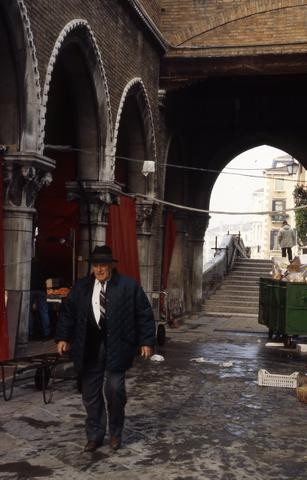
Italian Man on Street 01

Italian Man on Street 01480
Permalink to this Image | Gallery of Rachel's Works

One Essay Response

  1. maxholleran says:

    A man walks through a square in a terraced hill town. He is dressed in his finest but the square is somewhat dingy: the pavers are wet and have an oily sheen to them, crates, garbage bins, and hand-trucks are strewn about, and wires wrap columns and crisscross the sky. This is, in short, a space that is being used—frequently. The most functional urban localities are not always the prettiest. The heavily-used square that is home to debates, chance encounters, and mom-’n-pop vendors is, often, also home to crinkled newspapers, cigarette butts, and scruffy pigeons. This is the beauty of urban junctions—whether they are open-air markets, street corner hangouts, or transit nods—they are freewheeling space in which anything can—and does—happen.
    In our departure from tried-and-true methods of town planning (based on squares and walkable increments) we have lost this sense of possibility. In the hermetically sealed suburbs and exurbs (developed in North America but quickly spreading the world-over) chance encounters are minimized and the dramatic mixing of peoples (a draw to urban life since the days of Ur) has been kept to a minimum. The city based on small-scale squares and natural gathering places is quickly disappearing and, try as we might to synthetically recreate those effects in shopping malls, new urbanist communities, and theme parks, our simulacra of true urban spaces consistently disappoint. What is the value of preserving these spaces, one might ask, if new forms of interaction are cropping up that create virtual town squares without the noise and pigeon poop of the original?
    Simply put: the inclusivity of urban spaces is lost. In the self-selecting digital sphere the crowd consists only of our-type-of-people-people—a crowd that is, to be sure, comfortable to spend time around but lacks the true nuance and diversity of the urban square. In online interactions one does not have to deal with panhandlers, spurned lovers, or sticky benches and, as much as we claim to hate them, chance encounters with these exasperations (and not the creature comforts of city living) is what makes an urban space truly vital.
    In this photograph we see the possibility of a city not characterized by anomie and disjointedness but by warmth, rootedness, and possibility. While the surroundings are a bit rough one feels clearly located in them: situated and grounded by architectural elements scaled up only slightly from the human forms they echo. The spaces of Italian piazzas are, according to planning historian Kevin Lynch, classic examples of the “nod” in urban space: they are “highly differentiated and structured” but while “inside one feels always in clear relation” to the surrounding city (The Image of the City, p 78).
    In Rachel’s image we see the city, as it once was, in all of its glorious imperfection. It gives us pause and, hopefully, prompts us to think about how we can retain the qualities of urban life that make Italian squares so vital—vital to commerce, vital to democracy, and vital to a sense of belonging in the world.