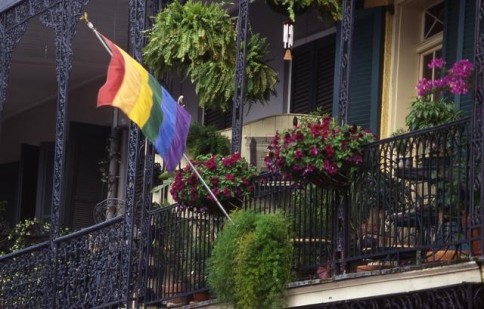
Rachel Tanur photographed this rainbow flag flying over a New Orleans street sometime before her passing in 2002. The photograph is undated, but I am certain that Rachel witnessed massive progress in the legal and social status of LGBT people over course of her lifetime. Illinois became the first state to decriminalize sodomy in 1962. In the following decades, 36 states would repeal their anti-sodomy laws or have them overturned in court. Lawrence V. Texas ruled that private sexual conduct was protected, therefore invalidating all state anti-sodomy laws in 2003. Obergefell v. Hodges legalized same sex marriage nationwide in 2015.
If a rainbow flag flying outdoors is a sign of America’s progress, then it is also a reminder of how geographically fragmented progress can be. New Orleans has been home to LGBT communities since the early 20th century, producing such creative luminaries as Truman Capote, Tennessee Williams, Big Freedia, and Tony Jackson. One of the deadliest incidents of anti-gay violence in history also happened in New Orleans, when an arsonist attacked the Upstairs Lounge in 1973. The fire killed 32 people. Louisiana has anti-sodomy laws on its books to this day though they are no longer enforceable. It is currently among the 27 states that do not have laws against anti-gay discrimination and 20 states that do not facilitate gender marker changes on state IDs [1].
An alternative way to read this scene is through the lens of cultural consumption. Though history and culture are intangible, they are still subject to the same treatment as consumer goods, and people can still experience them through market transactions. The LGBT scene in New Orleans—clubs, music, pride parades—is a major draw for tourists visiting New Orleans. The wrought iron awning of the building in the background is an architectural element commonly seen on Creole townhouses in the French Quarter, one of the most visited districts in all of New Orleans. With the confluence of these two, the rainbow flag could just as easily be a signal to visitors.
In recent years, several major cities have organized efforts to install the rainbow flag in public spaces. Chicago’s Boystown has a rainbow pillar permanently installed, and San Francisco has a rainbow crosswalk. LGBT iconography is now profitable for businesses in some neighborhoods, whether to signal progressive values or lure tourists in with promises of hedonistic adventure. Queerness and historic architecture like the Creole townhouses are now both agents of gentrification, which drives up rents and forces out established residents, gay and straight alike [2]. When Gilbert Baker created the rainbow flag in 1978, he hoped that the symbol would be used nationwide but he couldn’t have anticipated the degree of commodification. Baker never trademarked the design.
A rainbow flag flying outdoors on a New Orleans balcony is a sign of the LGBT community’s hard-won civil rights and cultural acceptance. In the neighborhood context of the French Quarter, it can also symbolize the subsequent commodification of queer culture for tourist consumption. It’s an example of a symbol triumphing, while the people it represents still struggle. So Rachel Tanur’s photograph sits, somewhere between establishment and the margins.
Rachel’s photo entitled New Orleans Balcony is not only aesthetically pleasing but holds a more dynamic meaning. Although historically marginalized in the U.S. and many other societies, relationships represented by this flag have gained grounds in getting the rights they deserve. The Stonewall Riots of 1970 in Greenwich Village galvanized the pride movement (Suh, 2014). In 1977, Harvey Milk became the first openly gay official, and used his position on the San Francisco Board of Supervisors to advocate for LGBTQ rights. He was murdered but became seen as a “humanitarian martyr for love” (Popova, 2015). A foundation, books, and movies have been made in his honor and for the benefit of the LGBTQ community. Although the AIDS epidemic got negative attention for the movement it also called for better understanding of the people in the growing group.
The photo shows a flag blowing in the wind near the center of the picture, calling notice to the central focus on the Pride Movement. The flag fits with the colors of the surrounding environment and looks like it belongs. The plant that grows around its base gives it more strength. New Orleans has long been a city of inclusion and new beginnings. The French Quarter’s particularly diverse demographic history gave rise to its architectural synthesis blending French, Spanish, Creole and American styles. Each corner gives visitors a new variety of enjoyment and history. New Orleans has been more accepting than most of the country, and it is fitting the LGBTQ population is represented there.
Immigrants entered New Orleans with the hope of the American Dream, they quickly learned the paradox of the idea. Although it is more accepting, each immigrant had to earn the right and ability to be called American, much like all immigrants that came here for freedom had to wait to become white. The Pride Movement has met much opposition but recently has begun to receive some of the rights they have been pursuing. In a sense, LGBTQ Americans are becoming a more normal, accepted part of society, similar to the process traversed by many immigrant groups.
Rachel’s photography sheds light on some dark corners of society and allows each scholar to analysis her photos. A rainbow holds all colors, including everyone who takes their identity. Rainbows are also a symbol to Christians, it is a sign from God that He will not flood the Earth again. To the Irish, it speaks to their legend of the leprechauns and a pot of gold at the end of a rainbow (McDermott, 2015). Most people are inspired by rainbows and excited to see the meteorological phenomenon in the sky. Now the rainbow is another symbol for equality and fairness for all.
You must be a Rachel Tanur Memorial Prize applicant to submit an essay response.
2 Essays
yjwu says:
Rachel Tanur photographed this rainbow flag flying over a New Orleans street sometime before her passing in 2002. The photograph is undated, but I am certain that Rachel witnessed massive progress in the legal and social status of LGBT people over course of her lifetime. Illinois became the first state to decriminalize sodomy in 1962. In the following decades, 36 states would repeal their anti-sodomy laws or have them overturned in court. Lawrence V. Texas ruled that private sexual conduct was protected, therefore invalidating all state anti-sodomy laws in 2003. Obergefell v. Hodges legalized same sex marriage nationwide in 2015.
If a rainbow flag flying outdoors is a sign of America’s progress, then it is also a reminder of how geographically fragmented progress can be. New Orleans has been home to LGBT communities since the early 20th century, producing such creative luminaries as Truman Capote, Tennessee Williams, Big Freedia, and Tony Jackson. One of the deadliest incidents of anti-gay violence in history also happened in New Orleans, when an arsonist attacked the Upstairs Lounge in 1973. The fire killed 32 people. Louisiana has anti-sodomy laws on its books to this day though they are no longer enforceable. It is currently among the 27 states that do not have laws against anti-gay discrimination and 20 states that do not facilitate gender marker changes on state IDs [1].
An alternative way to read this scene is through the lens of cultural consumption. Though history and culture are intangible, they are still subject to the same treatment as consumer goods, and people can still experience them through market transactions. The LGBT scene in New Orleans—clubs, music, pride parades—is a major draw for tourists visiting New Orleans. The wrought iron awning of the building in the background is an architectural element commonly seen on Creole townhouses in the French Quarter, one of the most visited districts in all of New Orleans. With the confluence of these two, the rainbow flag could just as easily be a signal to visitors.
In recent years, several major cities have organized efforts to install the rainbow flag in public spaces. Chicago’s Boystown has a rainbow pillar permanently installed, and San Francisco has a rainbow crosswalk. LGBT iconography is now profitable for businesses in some neighborhoods, whether to signal progressive values or lure tourists in with promises of hedonistic adventure. Queerness and historic architecture like the Creole townhouses are now both agents of gentrification, which drives up rents and forces out established residents, gay and straight alike [2]. When Gilbert Baker created the rainbow flag in 1978, he hoped that the symbol would be used nationwide but he couldn’t have anticipated the degree of commodification. Baker never trademarked the design.
A rainbow flag flying outdoors on a New Orleans balcony is a sign of the LGBT community’s hard-won civil rights and cultural acceptance. In the neighborhood context of the French Quarter, it can also symbolize the subsequent commodification of queer culture for tourist consumption. It’s an example of a symbol triumphing, while the people it represents still struggle. So Rachel Tanur’s photograph sits, somewhere between establishment and the margins.
[1]https://www.hrc.org/state-maps/
[2] “The ‘gaytrification’ effect: why gay neighborhoods are being priced out.” https://www.theguardian.com/cities/2016/jan/13/end-of-gaytrification-cities-lgbt-communities-gentrification-gay-villages
lexichosez20 says:
Rachel’s photo entitled New Orleans Balcony is not only aesthetically pleasing but holds a more dynamic meaning. Although historically marginalized in the U.S. and many other societies, relationships represented by this flag have gained grounds in getting the rights they deserve. The Stonewall Riots of 1970 in Greenwich Village galvanized the pride movement (Suh, 2014). In 1977, Harvey Milk became the first openly gay official, and used his position on the San Francisco Board of Supervisors to advocate for LGBTQ rights. He was murdered but became seen as a “humanitarian martyr for love” (Popova, 2015). A foundation, books, and movies have been made in his honor and for the benefit of the LGBTQ community. Although the AIDS epidemic got negative attention for the movement it also called for better understanding of the people in the growing group.
The photo shows a flag blowing in the wind near the center of the picture, calling notice to the central focus on the Pride Movement. The flag fits with the colors of the surrounding environment and looks like it belongs. The plant that grows around its base gives it more strength. New Orleans has long been a city of inclusion and new beginnings. The French Quarter’s particularly diverse demographic history gave rise to its architectural synthesis blending French, Spanish, Creole and American styles. Each corner gives visitors a new variety of enjoyment and history. New Orleans has been more accepting than most of the country, and it is fitting the LGBTQ population is represented there.
Immigrants entered New Orleans with the hope of the American Dream, they quickly learned the paradox of the idea. Although it is more accepting, each immigrant had to earn the right and ability to be called American, much like all immigrants that came here for freedom had to wait to become white. The Pride Movement has met much opposition but recently has begun to receive some of the rights they have been pursuing. In a sense, LGBTQ Americans are becoming a more normal, accepted part of society, similar to the process traversed by many immigrant groups.
Rachel’s photography sheds light on some dark corners of society and allows each scholar to analysis her photos. A rainbow holds all colors, including everyone who takes their identity. Rainbows are also a symbol to Christians, it is a sign from God that He will not flood the Earth again. To the Irish, it speaks to their legend of the leprechauns and a pot of gold at the end of a rainbow (McDermott, 2015). Most people are inspired by rainbows and excited to see the meteorological phenomenon in the sky. Now the rainbow is another symbol for equality and fairness for all.
You must be a Rachel Tanur Memorial Prize applicant to submit an essay response.